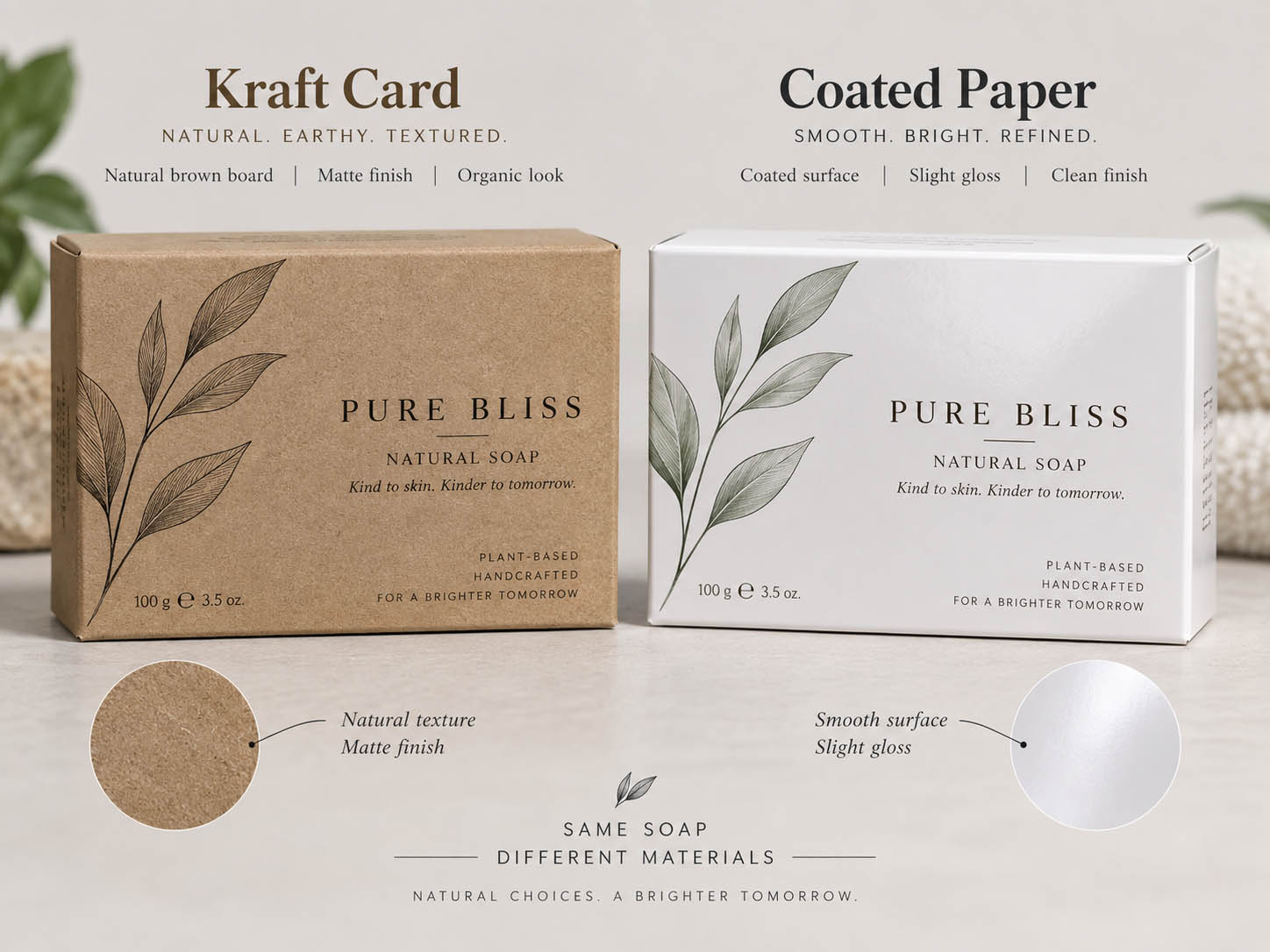
Kraft soap boxes win on board cost, a natural shelf story and plastic-free claims. Coated soap boxes win on print fidelity, oil and fragrance resistance and premium retail impact. For a bulk order, the decision comes down to three things: how many ink colours your artwork needs, how aggressive your fragrance and oil load is, and which sales channel the box has to survive.
This comparison comes from the packaging team at PackTaki, a custom packaging manufacturer producing cartons and bags for brands worldwide since 2016. If you are sourcing custom soap boxes for the first time, this guide focuses on the factors that actually move your unit cost, your defect rate and your reorder timing.
Key Takeaways
- What is the real difference? Kraft board is unbleached or bleached fibre with no coating layer. Coated board carries a clay coating that makes ink sit on the surface instead of soaking into the sheet.
- When kraft wins: natural and handmade soap brands, one or two-colour artwork, plastic-free mandates and cost-sensitive volumes.
- When coated wins: multi-colour brand palettes, Pantone accuracy, premium gift sets, and any bar with a heavy oil or fragrance load.
- Where the cost actually differs: not the board price. Coating, extra print passes, tooling and shipping volume usually decide the landed cost per 1,000 boxes.
- What to send before you request a quote: finished size, bar weight and shape, box style, colour count, barrier requirement, and your annual and first-order volumes.
1. What Kraft and Coated Soap Boxes Are Made Of
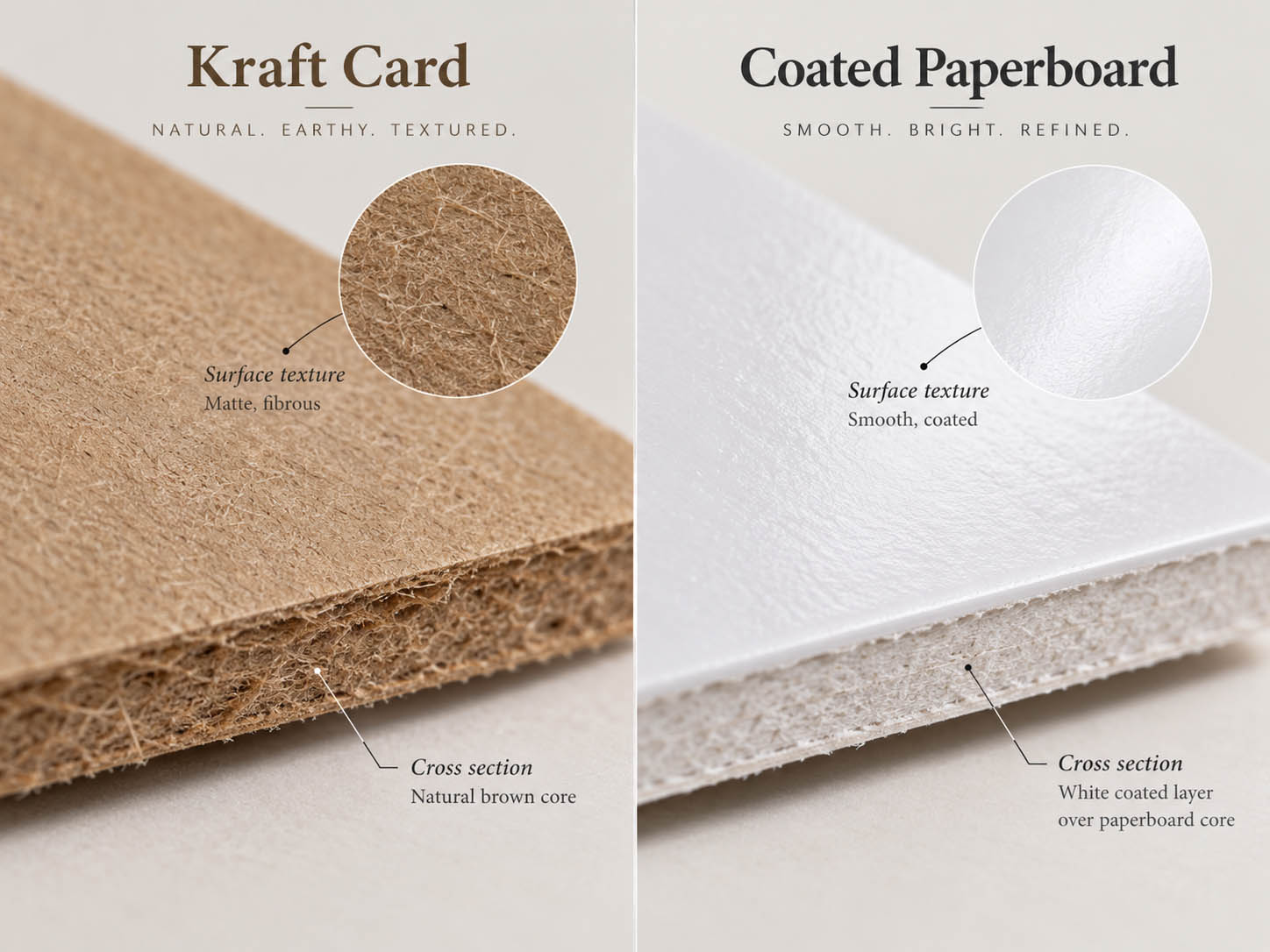
Kraft board is made from unbleached wood pulp, which is why it reads brown and matte. Bleached kraft is the same fibre family with the colour removed, so you get a white or cream surface without adding a coating layer. Coated one side (C1S) kraft sits between the two: one printable coated face, one natural back.
Coated soap boxes are usually built on solid bleached sulfate (SBS) or folding box board (FBB). A clay coating is applied to the print side, and the sheet is often finished with a film lamination, an aqueous varnish or a UV varnish. Soap cartons commonly run in the 250-400 gsm range, with 300-350 gsm covering most retail bars.
Board weights and available grades vary between mills and regions. Treat the ranges above as typical rather than a specification, and confirm the measured weight range with your supplier before you sign off artwork.
2. The Comparison Table: Cost, Print, Barrier, Lead Time
| Decision factor |
Kraft board |
Coated board (SBS / FBB) |
| Surface and shelf impression |
Natural brown or white kraft, matte, works as a "handmade" cue |
Smooth white surface, reads premium on a retail shelf |
| Print fidelity |
Ink soaks in; colours shift on brown fibre |
Ink sits on the coating; sharp detail and fine type survive |
| Colour consistency across batches |
Wider variation, harder to hold one brand colour |
Tighter control, easier Pantone matching |
| Oil and fragrance resistance |
Weak when uncoated; staining is common |
Better, especially with inner lamination |
| Barrier options |
Glassine or greaseproof liner, wax or PE coating |
Lamination, metallised liner or PE liner |
| Recycling story |
Uncoated kraft is widely accepted in paper recycling |
Coated board recycles in most systems; film lamination needs a local check |
| Tooling and print setup |
Fewer colours, lower plate cost |
More colours and foil passes, higher setup cost |
| Typical lead time |
Folding carton 10-15 working days |
Same base process plus a lamination queue |
For brands that also pack gift sets around the carton, kraft paper bags usually follow the same material logic: uncoated and plastic-free, at the cost of a narrower colour range.
3. Print and Color Consistency: The B2B Deal-Breaker
On uncoated kraft, ink is absorbed into the fibre. The result is dot gain, muted mid-tones and a visible shift on light colours. Reproducing a light brand colour on brown kraft usually means printing an opaque white underprint first, which adds a print pass and cost. Fine reversed type on uncoated kraft also tends to fill in, so line art and spot colours are safer than photographic gradients.
Coated board behaves the opposite way: ink stays on the coating, so fine lines, light tints and photographic imagery hold up, and repeat orders are easier to match.
Whichever board you choose, the acceptance standard has to be written down before production. Agree a colour reference such as an approved Pantone chip or a signed drawdown, approve a physical pre-production sample, and keep that sample as the reference for later batches. Colour tolerance values should be agreed per project with your supplier rather than taken from a generic table, because the acceptable range depends on board, ink and print method.
Finishing changes durability as well as looks. A matte film lamination scuffs less than an aqueous varnish during transit and shelf handling; a UV varnish gives gloss but can crack on a folded edge. Decide between matte and gloss before you approve artwork, because switching finish later means a new lamination run and a new sample round.
4. Oil, Fragrance and Moisture Resistance
A bar of soap is not a dry product. Free oils, essential oils, glycerine and fragrance migrate into the board. Uncoated kraft wicks them: you get translucent oil marks, a softened panel and measurable fragrance loss on the shelf. This is the single most common reason a "just use kraft" decision gets reversed after the first production run.
There are four practical barrier paths: an inner film lamination, a glassine or greaseproof paper liner, a wax or grease-resistant coating, or a coated board with lamination on the inside face. Bars with a high liquid-oil load usually need a liner regardless of board choice.
Test it before you commit. Put a finished bar in a closed, unlaminated box at ambient temperature and inspect it at 7 and 14 days: check for oil marks under the inner face, board softening and fragrance transfer. Then repeat with boxes stacked to simulate pallet pressure, and run at least one round in the season you normally ship, because summer transit is where barrier failures show up.
5. Total Cost per Unit: Where the Money Actually Goes
Most buyers compare board price per tonne and stop there. The number that matters is landed cost per 1,000 finished boxes, and it is built from six parts:
- Board: driven by board grade, gsm and the surface area of the box.
- Printing: the number of colours and passes; printed artwork on kraft may need an extra white underprint.
- Coating or lamination: a film lamination costs more than an aqueous varnish but protects the print better.
- Die-cutting and gluing: straight-line cartons use simple dies; windows, inserts and shaped panels need custom dies.
- Tooling (one-time): plate charges per ink colour; die charges for custom or windowed structures; separate foil and emboss dies if you use them. Ask three questions before you approve tooling: which items must be re-cut on a repeat order, who keeps the tooling, and whether any of it is credited back. As a rule of thumb, a size change normally means a new die, while a colour change on the same size normally means a new plate only for that colour.
- Freight: folding cartons ship flat, so dimensional weight rather than box size drives cost. A heavier board is not automatically the cheaper answer, because a liner inside a lighter board often protects better for less.
Comparing cost per 1,000 is also the right way to judge whether an upgrade is worth it, because tooling spread over a first order looks very different from tooling spread over a year of reorders. If your dimensions are still open, this guide to reading box dimensions before ordering is worth checking first, since a size change late in the process resets the tooling maths.
6. MOQ, Sampling and Lead Time Differences
Sampling should always be a physical pre-production sample after artwork approval, not a digital proof. Ask for it on the actual board you will produce on, and check colour, folding strength and liner fit in one go.
Lead times are similar in structure because both start as printed, die-cut folding cartons. As a typical range, folding cartons run 10-15 working days, with lamination, foiling or embossing adding time in the queue. Sea freight is commonly 18-22 days and air freight 5-7 days, so enquiry to delivery often lands at roughly 35-55 days.
Minimum order quantities depend on board availability and print method. Natural and speciality kraft sheets are often stocked in narrower ranges than standard white boards, so a kraft project can carry a higher minimum than the same box in coated board. Confirm both the MOQ and the board availability window before you build a launch date around it.
7. Compliance and Recycling Claims Buyers Must Verify
Three claims come up in almost every soap packaging enquiry, and all three need documentation rather than a verbal yes.
First, contact safety: if the box touches the product or sits in the same sealed pack, confirm the inks and coatings used on that face. Second, fibre sourcing: an FSC or equivalent chain-of-custody claim should be backed by a certificate, not by a marketing line. Third, recyclability: uncoated kraft is widely accepted in paper recycling, while film lamination and PE coating depend on the collection system in your target market, so check locally before printing a recycling symbol.
One practical point that is often missed: soap products need panel space for legal copy such as net weight, ingredients, batch code and barcode. Plan that space before the artwork is designed, because a busy print design on a small carton usually has to give up somewhere.
8. Which One Should You Choose? Decision Guide by Buyer Scenario
| Your situation |
Recommended choice |
| Handmade soap, small batches, one or two colours |
Uncoated kraft carton, paper liner, no film |
| Natural or organic line with a plastic-free mandate |
Uncoated kraft plus glassine liner; accept a narrower colour range |
| Premium gift set in brand colours |
Coated board with matte lamination and foil accents |
| Supermarket or pharmacy shelf, several SKUs |
Coated board for consistent colour across the range |
| E-commerce direct ship |
Coated or kraft carton as the inner box, protected by a corrugated shipper |
| High liquid-oil or strong fragrance bar |
Liner first, then choose the board around it |
The pattern is simple: kraft is a material decision, coated is a colour decision, and the liner is a product decision. Fix the liner question first and the board choice usually becomes obvious.
If your range flips between natural and premium lines the way kraft paper bags vs luxury packaging bags do, running two boards across two lines is often cheaper than forcing one board to do both jobs badly.
9. Sourcing Checklist: What to Send Your Supplier
Send these six items with your first enquiry and you will get a usable quote instead of a range:
- Finished box size in millimetres (length x width x height), plus the bar dimensions.
- Bar weight and shape, because round or shaped bars change panel structure.
- Box style: tuck-end, sleeve, two-piece, or windowed.
- Artwork files, colour count and Pantone references.
- Barrier requirement: liner, lamination, coating, or none.
- Annual volume, first-order quantity and expected reorder frequency.
Then hold these four acceptance items for the first production run: an approved pre-production sample, an agreed colour reference, results from your oil and fragrance test, and the board certificate if you print a sourcing claim. Add the reference numbers to your reorder file so the second order matches the first.
10. How PackTaki Approaches Kraft vs Coated Soap Box Projects
PackTaki has been producing custom cartons and bags since 2016, and three parts of how we work matter directly to the kraft-versus-coated decision.
The first is sampling. Projects move through artwork confirmation and a physical pre-production sample approval before production starts, so the board, the colour and the liner are settled on a real carton rather than on a screen.
The second is colour control. We work from Pantone references with colour management on press, which is normally what decides whether a kraft route or a coated route is realistic for a given brand palette.
The third is material sourcing. Recyclable, biodegradable and FSC-certified stocks are available across our production lines, so a kraft carton with a glassine liner can be quoted as a genuinely plastic-free set rather than a compromise.
We provide one-stop OEM and ODM customization with an in-house design team, covering design, sampling, production and global delivery. That covers both start-up brands ordering at low volumes and international brands ordering at mass-production scale. The factory sits close to Xiamen Port and Airport, which keeps air, sea and rail options open, and we support DDP/DDU door-to-door shipping with customs clearance.
If you want the fuller background, our custom packaging services set out what we produce and how we ship it.
FAQ
Is kraft board cheaper than coated board?
Usually yes on the paper itself, because there is no clay coating and no film lamination. The gap narrows or disappears when the artwork needs an opaque white underprint, or when the oil load forces a liner that the coated option already covered.
Can you print Pantone colours on kraft soap boxes?
Yes, but the brown fibre changes how the colour reads. Light or bright Pantone colours generally need a white underprint, adding a pass. Treat the kraft version as a close match rather than an exact one, and always approve a physical sample.
Do kraft soap boxes need a liner for oily bars?
If the bar carries free oils, fragrance or glycerine, assume yes. Uncoated kraft shows oil migration within days to weeks, and the marks are irreversible.
Are laminated soap boxes recyclable?
The board is recyclable in most paper systems; the film lamination is the variable. Check the collection rules in your target market before you print any recycling claim on the box.
Which is better for handmade soap brands?
Uncoated kraft with a paper liner, in most cases. It matches the positioning, keeps costs down, and stays inside plastic-free claims. Use coated board when a light or multi-colour brand palette must reproduce accurately.
What is the MOQ difference between kraft and coated soap boxes?
MOQ is driven by board availability and print method rather than by the board family itself. Speciality kraft grades are often stocked in narrower ranges, so the kraft option can carry a higher minimum. Confirm both MOQ and board lead time with your supplier before finalising a launch date.
Send us your soap bar dimensions, box style, artwork colour count and expected annual volume. The PackTaki team will come back with a board, structure and barrier recommendation for your specific product, fragrance load and sales channel, so you can compare cost per 1,000 boxes on paper rather than on assumption.
 English
 Français
 Español